
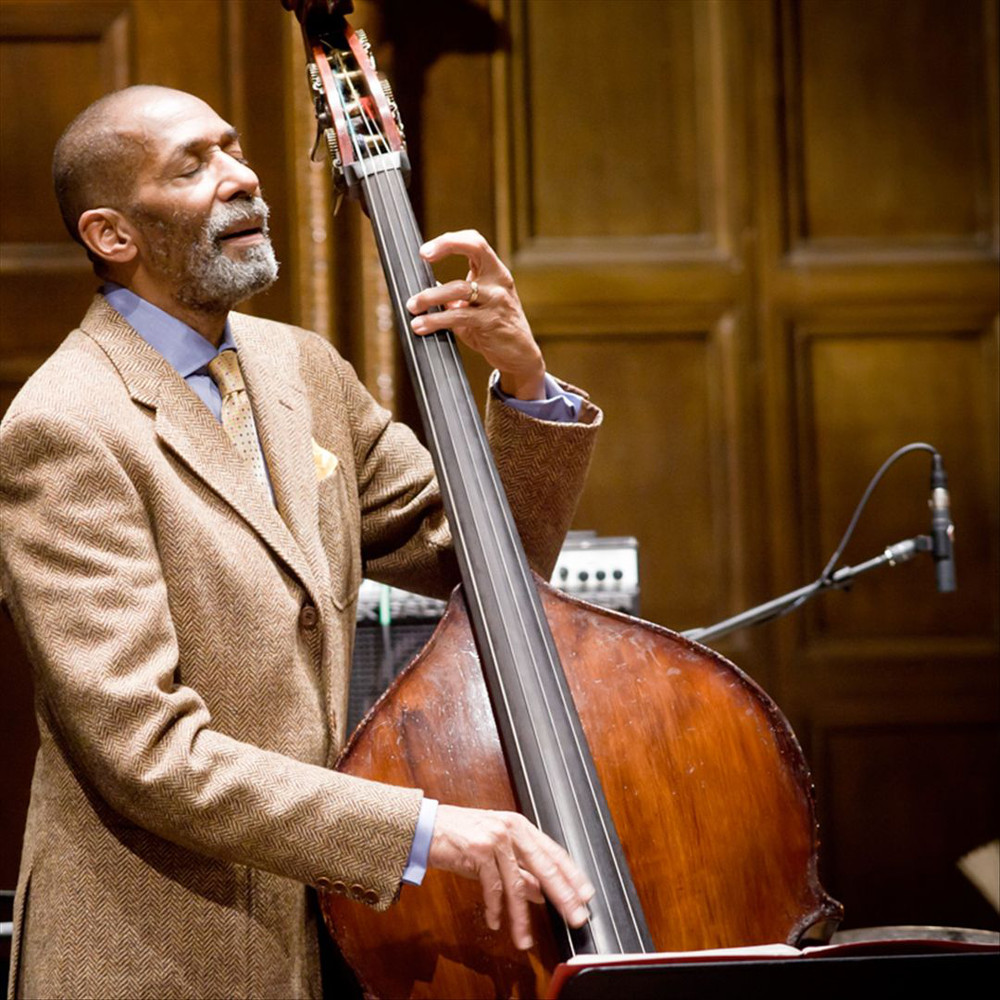
Ron Carter
Biography
Ron Carter (born May 4, 1937) is an American jazz double-bassist. His appearances on over 2,500 albums make him one of the most-recorded bassists in jazz history. Carter is also an acclaimed cellist who has recorded numerous times on that instrument. He was elected to the Down Beat Jazz Hall of Fame in 2012.
Carter was born in Ferndale, Michigan. He started to play cello at the age of 10 (1947), but when his family moved to Detroit, he ran into difficulties regarding the racial stereotyping of classical musicians and instead moved to bass. He attended the historic Cass Technical High School in Detroit, and, later, the Eastman School of Music in Rochester, New York, where he played in its Philharmonic Orchestra. He gained his bachelors degree at Eastman in 1959, and in 1961 a masters degree in double bass performance from the Manhattan School of Music in New York City.
Read full biography ↓
His first jobs as a jazz musician were with Jaki Byard and Chico Hamilton. His first records were made with Eric Dolphy (another former member of Hamiltons group) and Don Ellis, in 1960. His own first date as leader, with Eric Dolphy, Charlie Persip, Mal Waldron, George Duvivier, and a date also with Dolphy called Out There with George Duvivier and Roy Haynes and Carter on cello; its advanced harmonies and concepts were in step with the third stream movement.
Carter came to fame via the second great Miles Davis Quintet in the early 1960s, which also included Herbie Hancock, Wayne Shorter and Tony Williams. Carter joined Daviss group in 1963, appearing on the album Seven Steps to Heaven and the follow-up E.S.P., the latter being the first album to feature only the full quintet. It also featured three of Carters compositions (the only time he contributed compositions to Daviss group). He stayed with Davis until 1968 (when he was replaced by Dave Holland), and participated in a couple of studio sessions with Davis in 1969 and 1970. Although he played electric bass occasionally during this period, he has subsequently eschewed that instrument entirely, and now plays only acoustic bass.
Carter also performed on some of Hancock, Williams and Shorters recordings during the sixties for Blue Note Records. He was a sideman on many Blue Note recordings of the era, playing with Sam Rivers, Freddie Hubbard, Duke Pearson, Lee Morgan, McCoy Tyner, Andrew Hill, Horace Silver and others.
After leaving Davis, Carter was for several years a mainstay of CTI Records, making albums under his own name and also appearing on many of the labels records with a diverse range of other musicians. Notable musical partnerships in the 70s and 80s included Joe Henderson, Houston Person, Hank Jones, and Cedar Walton. During the 1970s he was a member of the New York Jazz Quartet.
He appears on the alternative hip-hop group A Tribe Called Quests influential album The Low End Theory on a track called "Verses from the Abstract". He also appears as a member of the jazz combo the Classical Jazz Quartet.
In 1994, Carter appeared on the Red Hot Organizations compilation album, Stolen Moments: Red Hot + Cool. The album, meant to raise awareness and funds in support of the AIDS epidemic in relation to the African American community, was heralded as "Album of the Year" by TIME. In 2001, Carter collaborated with Black Star and John Patton to record "Money Jungle" for the Red Hot Organizations compilation album, Red Hot + Indigo, a tribute to Duke Ellington.
Carter was Distinguished Professor Emeritus of the Music Department of The City College of New York, having taught there for twenty years, and received an honorary Doctorate from the Berklee College of Music, in Spring 2005.[4] He joined the faculty of the Juilliard School in New York City in 2008, teaching bass in the schools Jazz Studies program. Carter made a notable appearance in Robert Altmans 1996 film, Kansas City. The end credits feature him and fellow bassist Christian McBride duetting on "Solitude".
Ron Carter sits on the Advisory Committee of the Board of Directors of The Jazz Foundation of America as well as the Honorary Founders Committee. Carter has worked with the Jazz Foundation since its inception to save the homes and the lives of Americas elderly jazz and blues musicians including musicians that survived Hurricane Katrina.
Carter appeared as himself in an episode of the HBO series Treme entitled "What Is New Orleans."
Carters authorized biography, Ron Carter: Finding the Right Notes, by Dan Ouellette was published by ArtistShare in 2008.
In 2013, Carter was one of four judges at Jazz at Lincoln Centers 18th Annual Essentially Ellington competition and festival. Read more on Last.fm. User-contributed text is available under the Creative Commons By-SA License; additional terms may apply.
Biography text from Last.fm, available under CC BY-SA.